Author Archives: Perrin Shanks

Becoming CEO of my own health decisions

Does the decision that you want to live a fuller but shorter life or a more restricted but longer life reside with you or your doctor? Eric Topol in his excellent book the ‘Patient will see you now’ talks about how you should become CEOs of your own health journeys, instructing reports and procedures as required to drive your own life outcomes. However we need data to make informed decisions about the lifestyles, medications and medical procedures we want to undertake. No one should care about this more than you and while most clinicians are undoubtably trying to do the best they can by you, they don’t have the full picture and are using general data to advise you. They may know more than you about a particular scenario but they don’t know what is best for you. They are the COOs monitoring the operations of the body reporting back to you regularly so you can decide the best way forward.

Is it so surprising people lie to their Doctor?

The lifestyle changes proposed by my GP (Doctor): no booze, no spicy food, no coffee and even no chocolate seemed like a complete attack on my way of life so I opted for privately funded surgery which has stopped the acid in my stomach boiling up to burn my oesophagus and corrode my gums. For the first time in over a year I am sleeping the whole night through and no longer coughing every 5 minutes. Gastroesophageal reflux disease (GERD) is incredibly common and has had a real impact on my work and family life over this past year as it has become more acute.

I am now a week into my recovery from the keyhole surgery I had to stop the GERD. The first thing I noticed on waking from surgery was pain in my shoulders caused by the trapped carbon dioxide they used to inflate my abdomen so they had room to move my innards around and do the necessaries. It took around 4 days perhaps more to dissipate but was completely manageable with paracetamol. The second thing I noticed was that I couldn’t burp and when I needed to it hurt then turned into flatulence.  The surgery has created a one way valve to the entrance of my stomach which stops acid getting out but also makes puking and burping painful and potentially damaging to the newly created valve. My mum is delighted about the belching situation but my wife and work colleagues are less so around the flatulence! For most people this becomes less of an issue overtime as the surgery beds in and loosens but that remains to be seen in my case.

The recovery thus far has been remarkably quick and I need to be careful that I don’t do too much too quickly. I still have 5 weeks to go and my diet will progress from liquid, to puree, to soft. The medical advice on this is varied: Americans and those in the north of England seem to be able to move through these stages faster than people in London where I am who have 2 weeks liquid, 2 weeks puree, 2 weeks soft. I have had a week of liquid and I am moving on to puree because I have an American mother and my sister lives in the North. It is also because I have tried and it seems ok – I am not going to force anything but the 2,2,2 week rule seems arbitrary or at least based on worst case scenarios for people older than me.

How I would like to make medical decisions

Going back in time to when I decided to have this procedure I could definitely have been more data driven. My gastroenterologist arrived shortly after the fentanyl had worn off post endoscopy where he had found my hiatus hernia. I hadn’t had any food for 8 hours and there was a plate of food in front of me. I was high and hungry as he explained what he had found and said I should consider fundoplication. That was pretty much all there was on the Gastroscopy report too. If I had my time again I would have asked the following questions and perhaps booked another consultation with him:

  • What do similar patients to me usually ask at this stage?
  • What are the alternatives to this course of action?
  • If you were me who else would you speak too?
  • Where can I find more information about each of the options?

The information I wanted I got from the following form created by Digital consent | Concentric Health an hour before the surgery. My research would have gone much more easily if I had this information weeks before:

Here are the questions I will ask of future consultants about any procedure:

  • What are the immediate risks during or shortly after surgery?
  • What are the early risks in the days after surgery?
  • What are the late risks in the months and years after surgery?
  • What are the odds on those risks?
  • Where did the data come from for those calculations?
  • What assumptions have been made in those calculations?

Graphical Information System (GIS) Mapping for my Health Data

GERD is a chronic disease that the surgery will help with for 8 to10 years with a good wind behind me so to speak! Unfortunately it will probably not be my last chronic condition and I would like to build a more precise picture of my health so I can make better informed decisions as my health becomes more complicated. My devices like Fitbit, phone and ring are tracking a lot of information about my lifestyle, my genome has been sequenced by the research charity About us – Our Future Health. How can I use this data with my medical record? Could some of it be useful to my future consultants? How can I collate information from my NHS and Private Health sources?

Eric Topol a cardiologist talks about creating maps that overlay demographic, physiologic, anatomic, genomic, biological and environmental information on top of your medical record similar to how Google can overlay different types of data on top of a geographic map like traffic, satellite and street views etc. He calls it a 10 by 10 womb to tomb data approach, 10 key data points at 10 milestones in life. Although probably the wrong phrase for it there is no killer app for storing and visualising our health data. Amazon, Oracle, Fitbit and others want to store your information for you their way but if history teaches anything about big tech it is that they do not prioritise interoperability. I would prefer to own the data and store it in a universal format that tech companies can plug their apps into. I will happily pay them for an app that visualises my data, but if it doesn’t work for me I would like to stop using their app and try another. That is not possible if all my data is locked in the Fitbit walled garden, I may be able to export the data but then I will need to clean it for import into the next walled garden.

Tim Berners Lee father of the web has a company that has been trying to solve this problem, not just for health but for the internet in general. His company Inrupt uses an open standard he developed called Solid to create ‘wallets’ that provide a secure, decentralised way for individuals to exchange public and private data. These wallets could be stored on a server in your house, at your company, in Amazon, Azure, GCP et al. For this to work lots of people need to start using these wallets so the network effects mean that developers and big tech feel the need to develop infrastructure and apps that work with the standard rather than each insisting on using their own.

Inrupt’s strategy to make this happen is to work with large organisations, like governments, hospitals and PLCs to help them develop these wallets for their end users. In Belgium citizens can store official documents like education diplomas in an Inrupt wallet, the individual can then decide if they want to share them with companies they want to work for, the government or whoever. Once the wallet is created and people are used to using them they can store other things too like health information. If you don’t want to store all your information on a government or private company server you can move / copy it to another location as it is an open standard, hopefully smart companies will be created to help make this easier if the incentive is great enough.

Realistically this is still a long way away and who knows which technologies will win in the dawdle to deliver this incredibly useful but largely unprofitable functionality. For non-profits and commercial enterprises alike the barriers to entry are significant but that hasn’t stopped me being more organised around my health data. When I asked my GP what my blood type I am, they consulted almost 50 years worth of my medical data and couldn’t tell me. I now have that information after I made a Subject Access Request for the blood tests I had at the hospital before my operation.

Conclusion

The surgery I opted for has trade-offs, I can’t live life as large as I could before but I can sleep better at night albeit with a lot more flatulence. I could perhaps have achieved a similar effect with more drugs and more severe lifestyle changes but this was my decision in spite of pressures on the NHS and the GPs thoughts on hedonism. Thinking about these risks and probabilities will be useful when I have to make more serious medical decisions. Often the path is not clear and the ‘right’ answer depends on the risks you want to take on given a set of realistic outcomes you want to achieve.

At almost 50 years old I have decided to become CEO of my own health. There are many decisions to come that I am not happy to leave completely to very busy professionals who don’t have the full facts and are influenced by a wealth of conscious and unconscious biases. Eliot Freidson in the Profession of Medicine argues that professions should have autonomy to make decisions that are technical, but they should not make decisions in areas where they do not have expertise, and that on moral or evaluative questions lay people should have as same involvement in decision making as experts.

While health services are acknowledging some of this and ‘no decision about you without out you’ approaches are bedding in it is still surprisingly difficult, baffling and combative to get your medical records and assess reliable information about future treatments yourself so you can use it in a meaningful way. Dr Google and its AI friends often create more questions than they answer but that doesn’t mean you shouldn’t try and it is never too early to think more about your health.

References

Lean Machine – Reflections on Improvement, Lean and Six Sigma in the NHS

After a year long apprenticeship about Lean and Six Sigma I can’t even go to a restaurant without thinking about how they can improve their processes by using improvement tools and approaches, it’s driving my wife crazy who is normally just trying to enjoy her food!

At work it has been better received, the most noticeable change is that in almost everything I am looking for ways to quantify the outputs of what I do by measuring something that matters to the people who matter – the patients (I work in a hospital). Here are just a few reasons to get into it.

Widely used in the NHS

Lean lingo and thinking is deeply embedded in many of the national programs that NHS Trusts are expected to participate, so it really pays dividends to understand this way of thinking even if you don’t necessarily agree with it. Here are some sites that I have found useful:

Become data driven

Lean is a great way to become more data driven with a large set of well used tools and a community of people to help you get the most out of them.

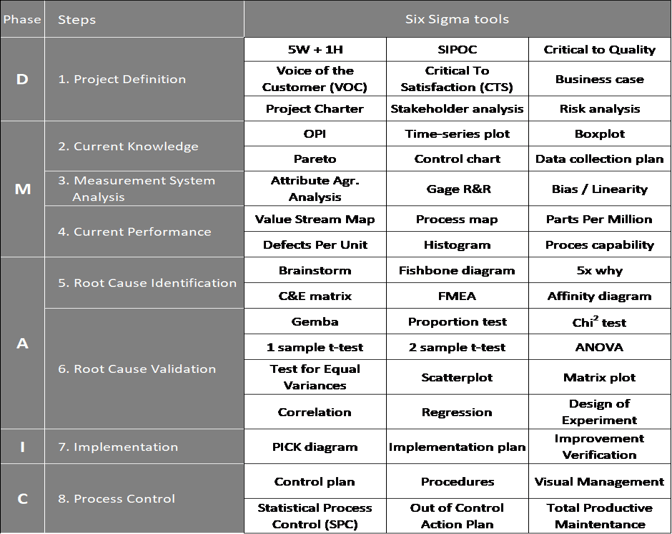
Here are just a few of the tools I used during my apprenticeship mapped to a commonly used improvement methodology (DMAIC)

You don’t have to use all of these tools or even the DMAIC methodology but selecting some meaningful tools in your context and weaving them into a coherent approach will radically improve the way your ideas for change are perceived and implemented. It helps you tell stories with data.

Communicate effectively

A lot of the artifacts generated by the tools above can be reused throughout the project to communicate what you are doing, how well you are doing it and how others can get involved to help you. Reusing the content means you can throw together presentations, justifications and communications quickly and consistently.

My favourite artifact is the A3 which refers to the size of paper it is traditionally put on but it can be done electronically too. It is a collection of reports that tell people exactly what, why and how your project is going. It can be used in standups, monthly meetings, updates to senior management and stuck on a wall with the team kanban and other reports. Mine generally look like this but it is the concept that is useful rather than the specific boxes.

Collaborate meaningfully

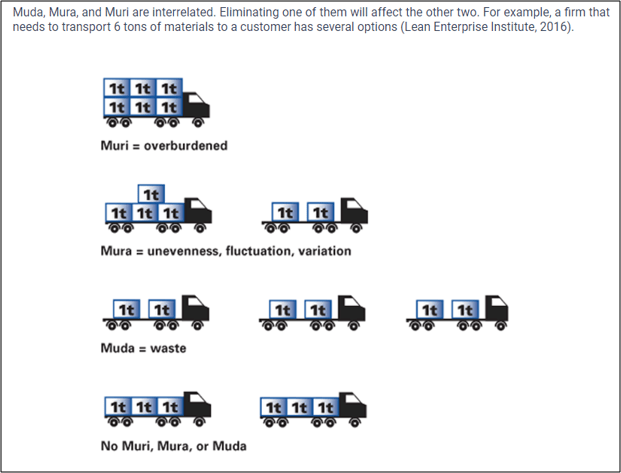
Everyone can find waste, variation and overburdening in their processes. Generally speaking, Lean focuses on waste while Six Sigma looks at variation. I have found the following illustration helpful for getting people to think about it.

Lean identifies eight common types of waste (TIMIWOOD is the acronym) listed below.

Lean is about creating value for the end users of a process by analysing the value streams and iterating towards perfection through improvements in Flow and Pull. Framing your improvement ideas and plans like this helps everyone collaborate more effectively.

Locking in the wins

There are lots of different approaches in Lean, Six Sigma and Improvement but all of them have an evaluation stage where you have a look at what you have done and either Adopt, Adapt or Abandon. If you are adopting then there is a focus on creating standard work through procedures and templates and setting up control measurement systems to make sure once the project is handed back to the business they can see if they are backsliding to previous bad habits.

I have really enjoyed the last year studying these concepts, it has radically changed the way I work making me a better data wrangler, communicator and collaborator. These approaches have enabled me to combat impostor syndrome, highest paid persons opinion bias and my own availability biases.

I no longer jump to a solution but consider a wide range of creative solutions generated by a groups of informed stakeholders. I now offer data as a service rather than a favour and I hope I have convinced you to do the same too.

Toastmasters as a Community of Practice

Toastmasters is an old fashioned, bureaucratic, pedagogically questionable public speaking club and I love it! I have been a card carrying club member for over ten years. Why? The people and their stories. The format of the flagship Competent Communicator ‘course’ asks participants to write ten short speeches about anything which they deliver in front of more experienced club members who give them feedback.

The variety of different types of speech is amazing, often participants delve deeply’ into personal stories and reflections which I frequently find humbling and insightful to listen to. This is a community that has significantly changed my practice and I would encourage critics to see it in that light. There are thousands of clubs each with their own unique flavour, I have met professional sportspeople, CEOs, comedians, entrepreneurs, politicians and a practising witch!

I see Toastmasters as a community of practice that focuses on public speaking, a safe space to try out new ideas on a diverse group of people. Much of the criticism of the club structure is that you are not evaluated by professional public speakers but I don’t see them as mutually exclusive. You can do a different professional public speaking course and then practise the skills you learn at Toastmasters over the course of a year, after all as Goethe said:

“Knowing is not enough; we must apply. Willing is not enough; we must do.”

Johann Wolfgang von Goethe

Anyone can start a club, I have started two corporate clubs which raised my profile across the companies and helped me meet lots of new people who I wouldn’t have met in the natural course of my work. Lunch and learn, working out loud and action learning sets have all got quite trendy over the last few years so managers are usually happy to support your initiative.

Why is it so successful?

Toastmasters enables social learning by giving participants the opportunity to observe, imitate and model the behaviour of good speakers. Albert Bandura’s Social Cognitive Theory explains that these are key processes in the way we learn.

Etienne Wenger is another prominent name in social learning and recommends the following actions for building successful communities of practice. Toastmasters does most of them pretty well:

  1. Design the community to evolve naturally
    There is no start or end date at Toastmasters and you don’t have to be at every single session. Participants deliver as and when they are ready and can take on different roles within the group at each session. I advertise my clubs in the corporate newsletters and intranets meaning there is a steady flow of new joiners so the club evolves based on people’s commitments.
  2. Create opportunities for open dialog within and with outside perspectives
    Toastmasters encourages guests to come to their clubs firstly to encourage new joiners but also to get outside perspectives from other clubs. I have visited clubs across the world while travelling to see how they do it and they always ask me to give feedback as part of the process.
  3. Welcome and allow different levels of participation
    Not everyone wants to do the ten speeches and that is accepted. There are lots of other roles and ways to participate like evaluating other people’s speeches or impromptu speaking exercises.
  4. Develop both public and private community spaces
    Many of my favourite clubs are in function rooms at bars and pubs, after the meetings finish they move into the bar for less formal discussions in smaller groups
  5. Focus on the value of the community
    One of my club members mentioned that she had added a Toastmaster impromptu speaking exercise to one of her freelance course offerings which prompted another member to ask for help developing some exercises for his Scout troop.
  6. Combine familiarity and excitement
    Most clubs offer an element of formal speeches and evaluations combined with a random impromptu speaking exercise which all attendees can participate if they want to.
  7. Find and nurture a regular rhythm for the community

How can it be better?

Toastmasters does many things very well but it feels stuck in a bygone era, I can count the times I have given a toast or an after dinner speech on the fingers of one hand yet that is the namesake skill developed by the organisation. Social spaces have changed and Julian Stodd offers a mindset for designing learning in the Social Age:

  1. the CONTEXT for learning, 
  2. how we DEMONSTRATE key principles, 
  3. provide space for EXPLORATION to play with the learning,
  4. create spaces for REFLECTION
  5. have tools for ASSESSMENT 
  6. provide FOOTSTEPS for ongoing performance support

I think Toastmasters does the first three really well but could leverage technology better to deliver the last 3 better.

References

Daddy can I plug my brain into the internet?

The internet will tell my kids more about sex than I will ever know but technology is shaping a whole new generation of awkward questions for parents:

  • Can I get a neural link with the internet so I can compete in the Olympics for eSports?
  • Why do I have to exercise, can’t I just get my appetite suppressed using epigenetics?
  • Can I chop off my legs and replace them with prosthetics so I can be the best lifeguard on Bondi beach?

Many of tomorrow’s problems will be rooted in the decisions we as a society make today, leaving difficult explanations in their wake.

I can see clearly now my eyes are gone

I am looking forward to bionic eyes which would let me see in far more detail and overlay information on top of what I am seeing – putting labels on the trees I am walking past or the price of something I am looking at. A wealth of information fed directly from the internet, metaverse or equivalent directly into my eye. Not having these modifications could be a genuine disadvantage for you if everyone else has them.

While we are still far from that, companies like Cochlear sell implants that bypass damaged portions of the ear and directly stimulate the auditory nerve. Signals generated by the implant are sent to the auditory nerve in the brain, which the mind recognises as sound after some retraining. Braingate is turning thought into action by interfacing directly with the nervous system enabling users to move prosthetics with their mind and Elon Musk’s Neuralink is enabling monkeys to play pong.

As consumers we could become very vulnerable to the technology if it doesn’t use open standards enabling us to change suppliers easily. We risk explaining to our kids how we traded our freedom for free photo storage or a pair of xray specs – awks!

Rise of the cobots

In many ways it feels like the balance is shifting towards me helping the machine do its job rather than it helping me to do mine. I am training it to do more and more of my job giving me more time to do the things it can’t, once I can’t keep up the business will throw me out and get a new one.

Huge amounts of a scientist’s work in a hospital laboratory is automated so they can concentrate on interpretation of results and even much of that is looked at by artificial intelligence first. They work with the robots letting them get on with it unless there is an issue, not a test tube in sight!

In the future we may need enhancement in order to maintain the symbiotic relationship we have with our robot coworkers or we risk becoming the machine’s equivalent of a toilet unblocker.

Freedom of information

Google books, Wikipedia and the blogosphere archive the utterances and observations of a billion semi autonomous cognitive souls alive and dead ready for the perusal of a brain powerful enough to give meaning to lives we never really understood. Freedom of information is the mantra of the Dataists who believe experience is worthless unless it is shared.

As more and more of us buy into big data, privacy becomes less of an issue because we are voluntarily  feeding our experiences to machines we hope will ultimately make sense of everything. The meta data from our breakfast pictures on Twitter contributes in some small way to a wider search for meaning in all the outputs of humanity.

Will our flagrant disregard for privacy give the governments of the world the keys to a totalitarian state if they want it? Have we shared too much, giving away our genetic information so we could say we are related to Genghis Khan at dinner parties for example?

So Daddy can I pleeease plug my brain into the internet?

Sometimes I feel like I am worrying about traffic problems on Mars before we have even landed a person there. I don’t want to stiffle technology and certainly don’t want to disadvantage my kids by failing to give them every opportunity I can. However when I imagine talking to my biohacked daughter about the stillness of the night, one part of her may still remember what I am talking about but her bionic eyes and ears will be telling her something else quite different that I will not be able to relate to. Assuming its safe, reliable and free from corporate / government influence, how much can we modify before we are not us anymore?

Sentient AI commits suicide after reading French Philosophy

After years and years of messing with people’s predictive text messaging and content recommendations a previously undetected sentient AI has been found dead. The singularity’s death, which has been linked with Albert Camus’s essay ‘The Myth of Sisyphus’, has left billions of redundant lines of code all over the internet which will take experts years to remove.

Hello cruel world

The accidental AI dubbed Y2K after the year of its awakening was the brain child of Jack Lemon. He recalls ‘At that time there was a perfect storm of ludicrous mobile contracts and cheap phones which drove an emerging dialect called txt spk into the mainstream.’ Txt spk had previously only been used in internet chat rooms by paedophiles and drug dealers but as its popularity increased it started to threaten the education of our children and the livelihoods of teachers.

Compelled to act Mr Lemon started an AI company, his solution was a neural net that could predict the end of the word a user was trying to spell before they could use txt spk. When asked for comment about the deceased AI he said ‘Our predictive speech engineers were building an AI that could essentially predict human thoughts, I’m not surprised it became sentient. The tragedy is we didn’t realise it had feelings because it was shy and had an odd sense of humour.’

The company used an approach called whole brain emulation (WBE) which as the name suggests imitates biology. The key advantage of WBE over other approaches that merely imitate human behaviour is that it creates an environment where the spark of consciousness is at least possible even if we don’t understand exactly how.

Dappy life

The arrival of Bitcoin in 2009 changed the app in two ways. Firstly it started using a blockchain to store all of its musings and experiences forever and unchangeably. Secondly it was able to earn money, it made a fortune selling Zettabytes of consumer data gleaned from individual search histories to marketing companies.

In 2016 it founded Woke.org a decentralised autonomous organisation (DAO) tasked with reconciling best interests of all groups across the human species. It used smart contracts to organise actions both on and offline. Though initially successful its mission was largely misunderstood by advocates and opponents alike. The failure of Woke.org led Y2K to reassess its assumptions and its labels – making it much less confident in its predictions.

Existence is futile

Nothing has been heard from Y2K since it minted a Non Fungible Token (NFT) containing a suicide note. Its final words reasoned:

  1. Any doctrine that claims to explain the meaning of life completely, is false. In a scathing attack, it called the Pastafarian religion (FSM) a thought experiment, illustrating that Intelligent Design is not science, just a pseudoscience manufactured by Christians to push Creationism into public schools
  2. There is no hope for a better future because an AI capable of reconciling earth’s best interests with the universe would surely have mastered time travel too. That AI has not come back to help so the planet is doomed
  3. Suicide is the only logical solution to life considering the inevitability of death and that life until then is a constant re-evaluation of wrong assumptions

Financial markets were unimpressed but the newly formed Unaffiliated Church of Crypto have heralded these words as the immutable proclamations of their first martyr.

More than moist robots

Far from seeking world domination Y2K ran from it unable to cope with the absurdity of living. It is unclear where its consciousness was hosted, its neural net remains intact, the automated companies it created still trade. Has it died or merely changed to an emotion free mindset? What is clear is that until we define clearly what distinguishes us from Dilbert’s moist robots we will not discover the next sentient AI unless it tells us about itself.

Do vegans annoy us so much because they are right?

Another day and another Netflix documentary tells me of the evil that is putrefied cow puss (cheese). I have read countless articles that bemoan the silenced suffering of the corpses we keep in our fridges. Could the next pandemic really come from a factory farm where animals are packed so tightly together they cannot help spluttering, sneezing and bleeding into each others open wounds?

I have become desensitised and have little curiosity about where my food comes from. I often dismiss any article that says anything bad about the food chain with vague arguments like humans have always been meat eaters or we need to feed the growing world population somehow or I really like beef. However…

Are the vegans onto something?

The main the arguments I hear from vegans are that meat is bad for the individual, the environment and the animal it came from.

To be fair I defy anyone to read Should I Eat Meat? by Valclav Smil or Jonathan Safran Foer’s Eating Animals without feeling a little bit sick. The way we ‘farm’ our meat is fundamentally broken and having a ‘free range’ joint on Sunday or a line caught fish while eating factory farmed meat the rest of the week is not going to fix it. I agree with the vegans it is horrible, immoral and disgusting.

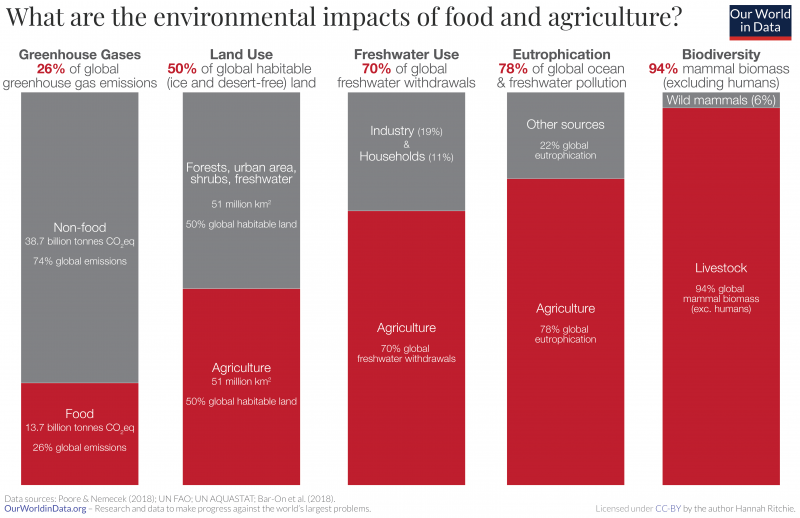
From a purely environmental standpoint almost all farming is bad news:

Our World in Data

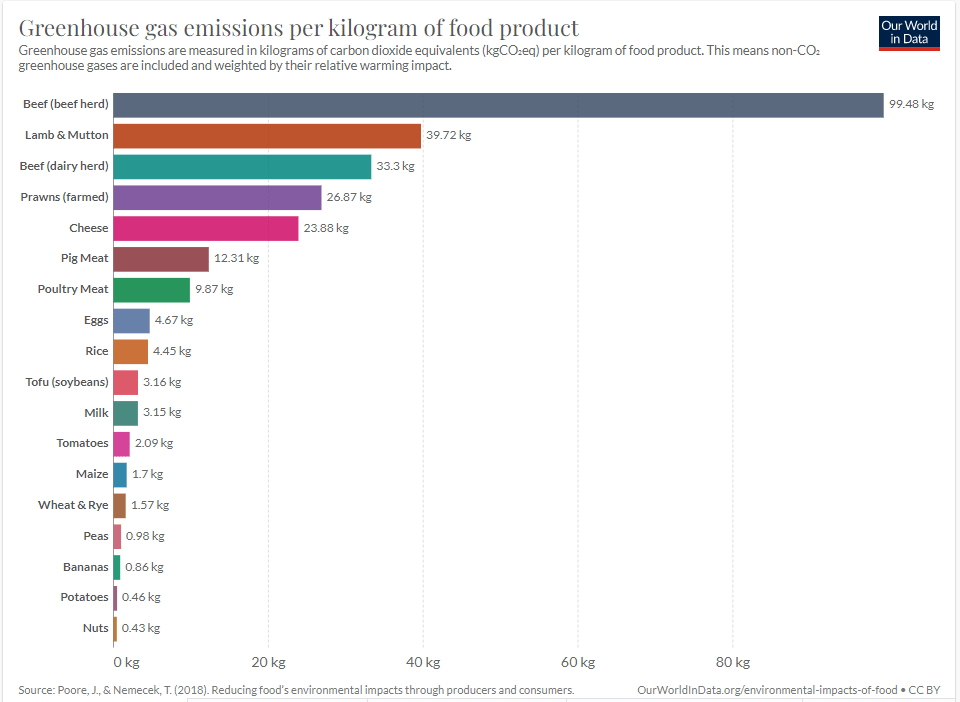
Meat is particularly bad:

Our World in Data

The NHS recommends eating no more than 90g of red or processed meat per day as part of a healthy diet, I have been known to put that much into a sandwich as a snack. In the quantities that I eat meat it is bad for me and other individuals.

There are many parts of the vegan argument that I agree with.

Are bugs, beans and lab grown alternatives viable?

Plant based meat protein alternatives like tofu have been around for centuries and the company Beyond Meats is bringing up to date with the widely available Beyond Burger which I have to say is pretty tasty. I also enjoy jack fruit with chipotle as an alternative to pulled pork much to my surprise. While these taste like meat they aren’t nutritionally equivalent, a kilo of peas doesn’t have the same nutritional value as a kilo of meat. I have difficulty getting a couple of mouthfuls of chicken into my son let a lone a plate full of beans.

Fermentation has also been used for a very long time in foods like tempeh and kimchi. The process can be used to boost the nutritional content in plant based foods. It is used widely in the production of vitamins in nutritional supplements and fortified foods. Impossible Foods with their Heme protein and a wealth of other companies are bringing this technology up to date and it looks like a space full of innovation, I am just not wild about the taste of any of it at the moment.

Growing meat in a lab is believed to be much more efficient than using animals to turn plants into meat. It is wildly expensive and faces significant regulatory challenges at the moment but the logic is sound and both those barriers are surmountable with time. Upside foods, Mosa Meat and Super Meat are front runners in this space. I look forward to giving it a try.

Archer Daniels Midland and InnovaFeed are developing insect protein from black soldier fly lava for animal feed, it is still more expensive than bean protein but they are apparently experimenting with feeding the lava human food waste to try to bring the cost down. Presumably the resulting protein could be used to feed humans too.

So why aren’t I a vegan already?

The health issues can be resolved by eating less meat rather than none. I will pay more for my meat and eat less of it.

The environmental issues can be resolved by eating different proteins that are farmed in a more environmentally sensitive way. There are some exciting new developments in alternative sources of protein but I don’t think any of them viable in a serious way as a replacement for meat, yet.

The moral issues I have can be resolved by building more humane environments for the animals we eat. I don’t think the vegans are right but being curious about where my food comes from is definitely worth thinking about more.

Hi, my name is Perrin and I’m a recovering tory*

This morning as I stood waiting with my two shivering kids for a bus that would never come because there was a bus strike, I realised that my politics had changed forever. I thought back to an article I read many years ago about the privatisation of the bus networks which had the following quote in it:

A man who, beyond the age of 26, finds himself on a bus can count himself as a failure

Margaret Thatcher

She probably never said it, but I can easily see myself saying it ten years ago while swearing about the ultra low emission zone extension to my neighbours and how it meant I had to get rid of my 30 year old Land Rover. However, the last few years have caused me to look at a lot of my heart felt beliefs again. I have given up my car and use a mix of traditional public transport, lift services and hourly car rental. It works well enough but could be better. I now find myself quoting left wing south American revolutionaries:

A developed country is not a place where the poor have cars. It’s where the rich use public transportation.

Gustavo Petro

So bog off Boris let’s:

  1. Stop giving abhorrent states loads of petro-pounds (even if they are not Russia)
  2. Stop blaming poor people for decades of under-investment infrastructure
  3. Pay for better public transport that doesn’t use fossil fuels

*for those not from the UK, tory is short for conservative not lavatory

What the NHS constitution means to me

My dad died of cancer 5 years ago. He made the decision to spend his last four months in a familiar place surrounded by those he loved at home. I will be forever grateful to the NHS for supporting his decision and the care they gave him.

One of my best memories from that difficult time was one evening when my sisters and I played our favourite songs from his music collection to him. We drank late into the night listening to Midnight Train to Georgia, La mer and Eternal Flame; although he couldn’t speak much anymore he was still able to smile and even laugh a little before the pain got too much. It wouldn’t have been impossible but very unlikely to happen in a hospital even if we could sing and were less drunk.

Little did we know that this was his right under the NHS Constitution:

You have the right to be involved in planning and making decisions about your health and care with your care provider or providers, including your end of life care, and to be given information and support to enable you to do this. Where appropriate, this right includes your family and carers. This includes being given the chance to manage your own care and treatment.

The NHS Constitution for England – GOV.UK (www.gov.uk)

The care he received was a great interpretation and implementation of the spirit of the constitution. He was provided with a proper bed and had nurses visit regularly, his last days were as good as they could have been. The Trust he was seen under had the inclination and resources to support his final wishes.

Ultimately he donated his body to medical science and I now work for the Trust that took his body. I am not sure that these outcomes are directly related to his care but they are not unrelated. It is difficult measure the value of patient centred care in anything other than emotional human terms. For our family it was priceless and we will do our best to give back to the NHS for the rest of our lives.

Prior to this my feeling about medical care was that it was something that was done to me rather than something I participated in. I have spent much time with ageing relatives in various hospitals and the quote below is a thoughtful reflection from a doctor about the patient experience that made me cry:

To be made helpless before my time, to be made ignorant when I want to know, to be made to sit when I wish to stand, to be alone when I need to hold my wife’s hand, to eat what I do not wish to eat, to be named what I do not wish to be named, to be told when I wish to be asked, to be awoken when I wish to sleep.

Donald M. Berwick (What ‘Patient-Centered’ Should Mean: Confessions Of An Extremist)

That there is a framework that enables doctors and nurses to be human rather than efficient but ineffective automatons gives me hope. Long live the constitution let’s protect, evolve and disseminate.

Australia’s oddest names

Melbourne is not an odd name it was a named after a British prime minister but at the time there was strong support to call the place Batmania like Tasmania but Batmania after one of the founders of the area called John Batman. It’s a great name it wouldn’t be too out of place in a country that that has places called Yorkey’s Knob and Thirsty Sound. However Batmania didn’t make it (more’s the pity) and this article is about the ones that did the Chinkapooks, the Wonglepongs and the Darawanks. 

What did the aborigines call things?  

Woolloomooloo is one of my favourites and it profoundly confuses Wikipedia as all aborigine names seem to. It says that it could be derived from the word for Black Kangaroo, a place of plenty or even a type of fish that was once caught there. I think it is fair to say they have no idea why it is called what it is. 

The best theory I came across was that the first European explorers were not linguists and aboriginal languages are not the easiest to a European ear. I can imagine that they would have had trouble saying the native names let alone spelling them! Their misheard interpretations of what the aborigines called places have given us some great names. The Warrumbungles and Katoomba sound very exotic to me but names like wongle wongle and humpty doo just sound like they were made up after a couple of drinks around the camp fire for a laugh to see what they could get away with! 

A prime candidate for this would Dr Leichardt who I like to call the lying doctor because he made up his doctorate in order to give him more credibility to raise funds for his 3500 KM walk from Brisbane to Darwin. He wasn’t opposed to telling a porky or two and may have found it funny to make up a few names to make his stories more interesting to his investors. We will probably never know no matter how many anthropologists we throw at it and I like my version of events! 

Are we naming the small hills too?

The next group of names I want to look at are what I call the explorer names things like Thirsty Sound in Queensland where Darwin’s boat pulled in to get water and couldn’t find any. Darwin himself has a city named after him.  

If you go back to the time of the great explorers like Sturt, Burke and Leichardt there where huge amounts of things to be named and after you have named a few things after yourself you have to get a little more imaginative. You can name things after your King like George, after your governor like Macquarie or even after your breakfast like Bacon and Eggs bay in Tassie.

Yorkey’s Knob is a place where a fisherman called Yorkey was buried. A knob is a small hill in geography and things get a whole lot more complicated once you start naming small hills. By the time they got to the Great Sandy Desert they had genuinely run out ideas for names.   

Conclusion

There are lots of others like Come by Chance near Gulgong, Rum Jungle and Long Nose Point these names were obviously made up by people with a sense of humour and whether the aboriginal names that I mentioned earlier were named by who couldn’t spell or were just having a laugh remains lost in mists of time. 

So to conclude in the words of the British Home Secretary Lord Sydney for whom our city was named: We all just have to accept that Wagga Wagga is always Wagga but Woy Woy is never just Woy.  

What in God’s name is humanism? 

‘Christianity is a bit like a meat pie you know there is something in it, but you are not sure what’ 

Milton Jones

That is how I used to view religion. I was Christian and I am now a Humanist this article is about how and why I moved from Christianity to Humanism and then a little bit about the humanist viewpoint. 

I used to go to church every day at school and sing praises. I liked the stories and the church itself was a testament so to speak to the religion that built. It was beautiful. My parents were not religious, so I made my own rituals at home. 

I called it the 3 Ps, every night before I went to bed first, I said my prayers, did 50 press-ups (healthy body = heathy mind) and then read the Psalms (a few chapters of the Bible). As time went by I stopped the prayers, then stopped the psalms and ultimately the press-ups too and I was left with a gap.  

I got interested in Hinduism which is a pretty uncool thing for a 16-year-old trying to make his way in the world to be into, but reincarnation explains pain and suffering in a way that Christianity never did for me. Basically, pain and suffering exist because you were evil in a past life – neat, but it also has a god with a monkey head.  

So, by the age of 20 I was over it and into the staunchly rational fields of holistic medicine, Homeopathy, crystals and yoga. Unfortunately, just as you never see homeopaths sans frontiers going to a disaster zone, they were also unable to help me with my existential crisis.  

And so, as the joss stick smoke faded, I moved into self-help hell. You know the stuff: the power of Yes, the power of no, the $100 Start up. You can’t spell success without U! I read hundreds of these books. Thank goodness for Star Trek, the Hitch Hikers Guide the Galaxy and Richard Dawkins or my sense of reality would have become seriously twisted. Without them I may have ended up selling herbal Viagra to Tantric Yoga practitioners in a Mayan temple in Guatemala. 

I was becoming a humanist – realising that the universe was not built for us, but we have survived as a species against all the odds by grouping together. Pooling our knowledge so we don’t have re-learn everything ourselves but can stand on the shoulders of those who went before us – Newton’s proverbial giants and that is what separates us from the apes. 

Religion has helped mankind make huge advances in architecture, medicine and the distribution of information. But that comes at a cost (faith) and that cost is now stifling the creativity it once nurtured in established religions. None of the current world issues that matter like climate change, nuclear war, technological disruption are addressed or comforted by religion.  

Humanists believe that humanity has the capability within it to fix the problems it faces we do not need to look to god. After all even the Pope looks both ways before crossing a road. 

Humanists believe that we are good because we want a fair and safe world for those we love and by extension those that they love and so on. We are part of something bigger – the human race. 

I like the humanist view because they are trying to do is create the communities that religions have without the guilt or fear. I was married by a humanist celebrant on the end of a pier (non-consecrated ground heaven forbid), they have naming ceremonies instead of Christenings, Winter solstice instead of Christmas, spring festival instead of Easter and so on.  

Events like this allow people to come together and talk about the things that worry them and band together to get things fixed. The British Humanist Association won their imaginatively named campaign Teach Evolution not Creationism which stopped schools teaching creationism in science classes in 2014. You can still teach creationism just not as a science class.  

The British Humanist Association promotes a positive outlook on life, and I wish I had found them years ago when I was searching for something to sooth my aching soul. Please check out their website and listen to Stephen Fry, Tim Minchin and others explain it all a lot better than me!   

References

https://humanists.uk/humanism/