Category Archives: Analytics

Becoming CEO of my own health decisions

Does the decision that you want to live a fuller but shorter life or a more restricted but longer life reside with you or your doctor? Eric Topol in his excellent book the ‘Patient will see you now’ talks about how you should become CEOs of your own health journeys, instructing reports and procedures as required to drive your own life outcomes. However we need data to make informed decisions about the lifestyles, medications and medical procedures we want to undertake. No one should care about this more than you and while most clinicians are undoubtably trying to do the best they can by you, they don’t have the full picture and are using general data to advise you. They may know more than you about a particular scenario but they don’t know what is best for you. They are the COOs monitoring the operations of the body reporting back to you regularly so you can decide the best way forward.

Is it so surprising people lie to their Doctor?

The lifestyle changes proposed by my GP (Doctor): no booze, no spicy food, no coffee and even no chocolate seemed like a complete attack on my way of life so I opted for privately funded surgery which has stopped the acid in my stomach boiling up to burn my oesophagus and corrode my gums. For the first time in over a year I am sleeping the whole night through and no longer coughing every 5 minutes. Gastroesophageal reflux disease (GERD) is incredibly common and has had a real impact on my work and family life over this past year as it has become more acute.

I am now a week into my recovery from the keyhole surgery I had to stop the GERD. The first thing I noticed on waking from surgery was pain in my shoulders caused by the trapped carbon dioxide they used to inflate my abdomen so they had room to move my innards around and do the necessaries. It took around 4 days perhaps more to dissipate but was completely manageable with paracetamol. The second thing I noticed was that I couldn’t burp and when I needed to it hurt then turned into flatulence.  The surgery has created a one way valve to the entrance of my stomach which stops acid getting out but also makes puking and burping painful and potentially damaging to the newly created valve. My mum is delighted about the belching situation but my wife and work colleagues are less so around the flatulence! For most people this becomes less of an issue overtime as the surgery beds in and loosens but that remains to be seen in my case.

The recovery thus far has been remarkably quick and I need to be careful that I don’t do too much too quickly. I still have 5 weeks to go and my diet will progress from liquid, to puree, to soft. The medical advice on this is varied: Americans and those in the north of England seem to be able to move through these stages faster than people in London where I am who have 2 weeks liquid, 2 weeks puree, 2 weeks soft. I have had a week of liquid and I am moving on to puree because I have an American mother and my sister lives in the North. It is also because I have tried and it seems ok – I am not going to force anything but the 2,2,2 week rule seems arbitrary or at least based on worst case scenarios for people older than me.

How I would like to make medical decisions

Going back in time to when I decided to have this procedure I could definitely have been more data driven. My gastroenterologist arrived shortly after the fentanyl had worn off post endoscopy where he had found my hiatus hernia. I hadn’t had any food for 8 hours and there was a plate of food in front of me. I was high and hungry as he explained what he had found and said I should consider fundoplication. That was pretty much all there was on the Gastroscopy report too. If I had my time again I would have asked the following questions and perhaps booked another consultation with him:

  • What do similar patients to me usually ask at this stage?
  • What are the alternatives to this course of action?
  • If you were me who else would you speak too?
  • Where can I find more information about each of the options?

The information I wanted I got from the following form created by Digital consent | Concentric Health an hour before the surgery. My research would have gone much more easily if I had this information weeks before:

Here are the questions I will ask of future consultants about any procedure:

  • What are the immediate risks during or shortly after surgery?
  • What are the early risks in the days after surgery?
  • What are the late risks in the months and years after surgery?
  • What are the odds on those risks?
  • Where did the data come from for those calculations?
  • What assumptions have been made in those calculations?

Graphical Information System (GIS) Mapping for my Health Data

GERD is a chronic disease that the surgery will help with for 8 to10 years with a good wind behind me so to speak! Unfortunately it will probably not be my last chronic condition and I would like to build a more precise picture of my health so I can make better informed decisions as my health becomes more complicated. My devices like Fitbit, phone and ring are tracking a lot of information about my lifestyle, my genome has been sequenced by the research charity About us – Our Future Health. How can I use this data with my medical record? Could some of it be useful to my future consultants? How can I collate information from my NHS and Private Health sources?

Eric Topol a cardiologist talks about creating maps that overlay demographic, physiologic, anatomic, genomic, biological and environmental information on top of your medical record similar to how Google can overlay different types of data on top of a geographic map like traffic, satellite and street views etc. He calls it a 10 by 10 womb to tomb data approach, 10 key data points at 10 milestones in life. Although probably the wrong phrase for it there is no killer app for storing and visualising our health data. Amazon, Oracle, Fitbit and others want to store your information for you their way but if history teaches anything about big tech it is that they do not prioritise interoperability. I would prefer to own the data and store it in a universal format that tech companies can plug their apps into. I will happily pay them for an app that visualises my data, but if it doesn’t work for me I would like to stop using their app and try another. That is not possible if all my data is locked in the Fitbit walled garden, I may be able to export the data but then I will need to clean it for import into the next walled garden.

Tim Berners Lee father of the web has a company that has been trying to solve this problem, not just for health but for the internet in general. His company Inrupt uses an open standard he developed called Solid to create ‘wallets’ that provide a secure, decentralised way for individuals to exchange public and private data. These wallets could be stored on a server in your house, at your company, in Amazon, Azure, GCP et al. For this to work lots of people need to start using these wallets so the network effects mean that developers and big tech feel the need to develop infrastructure and apps that work with the standard rather than each insisting on using their own.

Inrupt’s strategy to make this happen is to work with large organisations, like governments, hospitals and PLCs to help them develop these wallets for their end users. In Belgium citizens can store official documents like education diplomas in an Inrupt wallet, the individual can then decide if they want to share them with companies they want to work for, the government or whoever. Once the wallet is created and people are used to using them they can store other things too like health information. If you don’t want to store all your information on a government or private company server you can move / copy it to another location as it is an open standard, hopefully smart companies will be created to help make this easier if the incentive is great enough.

Realistically this is still a long way away and who knows which technologies will win in the dawdle to deliver this incredibly useful but largely unprofitable functionality. For non-profits and commercial enterprises alike the barriers to entry are significant but that hasn’t stopped me being more organised around my health data. When I asked my GP what my blood type I am, they consulted almost 50 years worth of my medical data and couldn’t tell me. I now have that information after I made a Subject Access Request for the blood tests I had at the hospital before my operation.

Conclusion

The surgery I opted for has trade-offs, I can’t live life as large as I could before but I can sleep better at night albeit with a lot more flatulence. I could perhaps have achieved a similar effect with more drugs and more severe lifestyle changes but this was my decision in spite of pressures on the NHS and the GPs thoughts on hedonism. Thinking about these risks and probabilities will be useful when I have to make more serious medical decisions. Often the path is not clear and the ‘right’ answer depends on the risks you want to take on given a set of realistic outcomes you want to achieve.

At almost 50 years old I have decided to become CEO of my own health. There are many decisions to come that I am not happy to leave completely to very busy professionals who don’t have the full facts and are influenced by a wealth of conscious and unconscious biases. Eliot Freidson in the Profession of Medicine argues that professions should have autonomy to make decisions that are technical, but they should not make decisions in areas where they do not have expertise, and that on moral or evaluative questions lay people should have as same involvement in decision making as experts.

While health services are acknowledging some of this and ‘no decision about you without out you’ approaches are bedding in it is still surprisingly difficult, baffling and combative to get your medical records and assess reliable information about future treatments yourself so you can use it in a meaningful way. Dr Google and its AI friends often create more questions than they answer but that doesn’t mean you shouldn’t try and it is never too early to think more about your health.

References

Lean Machine – Reflections on Improvement, Lean and Six Sigma in the NHS

After a year long apprenticeship about Lean and Six Sigma I can’t even go to a restaurant without thinking about how they can improve their processes by using improvement tools and approaches, it’s driving my wife crazy who is normally just trying to enjoy her food!

At work it has been better received, the most noticeable change is that in almost everything I am looking for ways to quantify the outputs of what I do by measuring something that matters to the people who matter – the patients (I work in a hospital). Here are just a few reasons to get into it.

Widely used in the NHS

Lean lingo and thinking is deeply embedded in many of the national programs that NHS Trusts are expected to participate, so it really pays dividends to understand this way of thinking even if you don’t necessarily agree with it. Here are some sites that I have found useful:

Become data driven

Lean is a great way to become more data driven with a large set of well used tools and a community of people to help you get the most out of them.

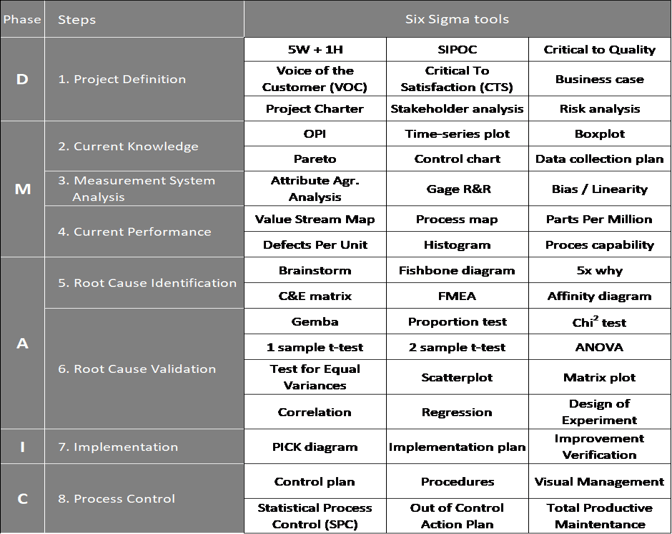
Here are just a few of the tools I used during my apprenticeship mapped to a commonly used improvement methodology (DMAIC)

You don’t have to use all of these tools or even the DMAIC methodology but selecting some meaningful tools in your context and weaving them into a coherent approach will radically improve the way your ideas for change are perceived and implemented. It helps you tell stories with data.

Communicate effectively

A lot of the artifacts generated by the tools above can be reused throughout the project to communicate what you are doing, how well you are doing it and how others can get involved to help you. Reusing the content means you can throw together presentations, justifications and communications quickly and consistently.

My favourite artifact is the A3 which refers to the size of paper it is traditionally put on but it can be done electronically too. It is a collection of reports that tell people exactly what, why and how your project is going. It can be used in standups, monthly meetings, updates to senior management and stuck on a wall with the team kanban and other reports. Mine generally look like this but it is the concept that is useful rather than the specific boxes.

Collaborate meaningfully

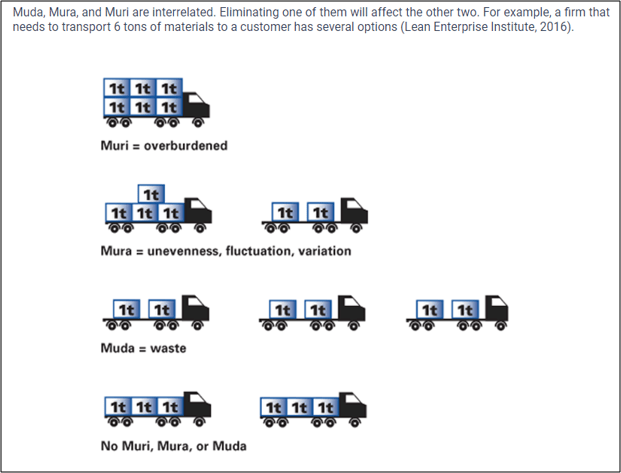
Everyone can find waste, variation and overburdening in their processes. Generally speaking, Lean focuses on waste while Six Sigma looks at variation. I have found the following illustration helpful for getting people to think about it.

Lean identifies eight common types of waste (TIMIWOOD is the acronym) listed below.

Lean is about creating value for the end users of a process by analysing the value streams and iterating towards perfection through improvements in Flow and Pull. Framing your improvement ideas and plans like this helps everyone collaborate more effectively.

Locking in the wins

There are lots of different approaches in Lean, Six Sigma and Improvement but all of them have an evaluation stage where you have a look at what you have done and either Adopt, Adapt or Abandon. If you are adopting then there is a focus on creating standard work through procedures and templates and setting up control measurement systems to make sure once the project is handed back to the business they can see if they are backsliding to previous bad habits.

I have really enjoyed the last year studying these concepts, it has radically changed the way I work making me a better data wrangler, communicator and collaborator. These approaches have enabled me to combat impostor syndrome, highest paid persons opinion bias and my own availability biases.

I no longer jump to a solution but consider a wide range of creative solutions generated by a groups of informed stakeholders. I now offer data as a service rather than a favour and I hope I have convinced you to do the same too.

Data privacy – is the juice worth the squeeze?

I love You Tube, Google, Twitter and for years have felt if they want to track my 200 episode obsession with Turkish period dramas or cat video likes then so be it. I’m not doing anything wrong so why would I care how it impacts my privacy? I then came across this quote in Oliver Stone’s Snowden movie and thought it was time to look into it further.

Saying you don’t care about privacy because you have nothing to hide is like saying you don’t care about freedom of speech because you don’t have anything to say. 

Edward Snowden

So what are they doing with your data?

An outraged father stormed into a well known US store to speak to the manager because the marketing team had sent his school age daughter discount vouchers for baby clothes and cribs. The store apologised profusely and said they would look into. A few days later the father called back to apologise and explain that his daughter was indeed pregnant.

Targeting is one of the most common uses of big data. The marketing department that so offended the pregnant girl’s father probably used a process like this:

  1. Segment – They purchased a list of new mothers or asked some to come forward as part of a survey. Next they found who on that list also had a store loyalty card or used a payment card
  2. Profile – Using payment or loyalty card data they could draw up a list of common product combinations these women had purchased while pregnant eg unscented lotions, folic acid, handbags that are big enough to hold nappies etc
  3. Engage – Looking at other customers who were buying those product combinations they generated a list of people who were probably pregnant and sent them Facebook adverts, coupons or email promotions
  4. Measure – Collected commission / bonus because of increased sales and boasted how good their predictive models were

Google, Facebook and many others hold vast stores of data about huge numbers of people which can be used to target you on the off chance that you might want to buy a washing machine 3 weeks after you searched for one online and then purchased in store. Some people find that creepy I find it clumsy but if they want to use my data for that broadly speaking I am not that bothered.

Can you trust large corporations to look after your data?

Half my life’s photos are on Facebook, when I needed to prove to my relationship status to the Australian government for visa purposes I used my Facebook timeline which showed over 5 years of dating with timestamps, places and photos. That is useful data to me, Facebook store it and make it easy for me to share. In return they know where I go out, who I hang out with, where I live, likes, dislikes, opinions on political issues, products I buy second hand on market place.

All of that sounded like a good idea when I first started using the site but since the Cambridge Analytica scandal, Equifax data breach and Sony hack there are some companies that I don’t trust anymore and I would like my data back please, it is the law after all. Great thank you, how do I know it is all there and can I upload it to a similar company easily. Unfortunately that bit is not so easy.

I would like to see a situation where when I hand my data over to a company they sign a list of my terms and conditions rather than the endless, unread end user licence agreements (EULAs) I click away to when I sign up to a new free service.

Tim Berners-Lee inventor of the World Wide Web has recognised this and has developed an open source specification called Solid that enables people to take back control of their data and privacy. It is only accessible to app developers at the moment but he has started a company called Inrupt to help organisations work with personal data in a way that benefits both parties with ultimate ownership of the data residing with the individual.

Broadly speaking the idea is to create a massive decentralised database where people store their data in a standardised format wherever they want. In my Facebook example I would upload a picture to my timeline but it would be stored where I tell them to store it and I would give them a key to access it. If I stopped trusting them I would change the locks and give the keys to another platform. The NHS, BBC, Natwest Bank and the Flanders government are early adopters of this specification. It remains to be seen whether it will catch on.

How can you make them give your data back?

The fact that you want to buy a sofa, TV or a chocolate bar is a valuable piece of information to the people who sell those things not because of the value of your sale but because of the future sales these companies will make due to a deeper understanding of their customers. It is possible that you could share that information and have companies fight over your sale in the form of discounts or benefits in kind on condition that you can have your data back if you want to at any point. Companies like Invisibly started by Jim McKelvey (Co-founder of Square) are experimenting with this at the moment.

The likes of Google, You Tube and Facebook have shown how valuable our data is to them by the sheer quality and scale of the ‘free’ products they offer us to harvest that information. The internet is now bubbling with decentralised apps ready to leverage better ways of sharing our data by building trust between individuals and organisations on a more level playing field.

Conclusion

The same data used to predict the likelihood of a person getting cancer can be used by health professionals to provide better proactive care or by an unscrupulous health insurance companies to suspend health cover before they become liable to pay for it.

To opt out of sharing health data, loyalty or bank cards because there may be a bad actor out there is to ignore the main issue which is we need more robust data privacy protections if we want to live in a modern world and take advantage of all that involves.

It will be hard but the juice of organisations striving to be trusted by their customers is worth the squeeze of setting up an infrastructure that enables customers to take away their data from negligent, corrupt or greedy organisations. However without an active body of individuals and government officials striving to guide companies that infrastructure will never materialise.

References

How Target Figured Out A Teen Girl Was Pregnant Before Her Father Did (forbes.com)

https://www.youtube.com/watch?v=eo6EjsSo_5A – Tim Berners Lee about Inrupt – turning the web right side up.

Home · Solid (solidproject.org)

A new era of innovation and trust in data | Inrupt

Are you making data driven mistakes?

The age of big data means we are all being encouraged to tell stories with data and compile numbers to show we are data driven. Clever dashboards and visualisations show us needles that need to be pushed, numbers that need to go green and curves that need to continually trend up. Much of this means we don’t need to think about why the numbers must go green – but go green they must.

I still feel a bit like a deer in headlights when I am asked to comment on data for the first time in meetings and haven’t had time to think about it. It feels a lot like brainstorming where I feel compelled to say either vague things confidently or stupid things because I haven’t had time to think them through. In this article I will look at some common data driven mistakes followed by some questions I use to sniff out potential problems that will lead to bad decisions.

Using only quantitative data to make your decisions

Robert McNamara was the US secretary of defense during the Vietnam war and modeled what success would look like based only on quantitative data. His plan sounds spookily familiar, he created clear objectives and achievable goals in the form of metrics so success could be reported on and easily understood by people not working in the war department. McNamara said that all the important quantitative measures indicated that they were winning the war despite what his generals were telling him. Daniel Yankelovich summarised the quantitative fallacy in 1972 like this:

The first step is to measure whatever can be easily measured. This is OK as far as it goes. The second step is to disregard that which can’t be easily measured or to give it an arbitrary quantitative value. This is artificial and misleading. The third step is to presume that what can’t be measured easily really isn’t important. This is blindness. The fourth step is to say that what can’t be easily measured really doesn’t exist. This is suicide.

McNamara had put too much faith in the data and had not factored in many variables that were hard or impossible to measure like the resilience of a soldier fighting for his home rather than his president.

This happens all the time when too much blind faith is put into a system, metric or some new technology. McNamara also believed that learning technologies could be used to make people smarter and as a result lowered the IQ requirement for the draft to 80; a policy subtly alluded to in the movie Forest Gump.

None of the data driven decisions I make will ever have the impact of these mistakes, but I strive to learn from history.

Looking for insight within the data you have rather than the data you need

Like the old joke where a drunk man is looking for his keys under a lamppost rather than where he lost them, in corporate training it is common to use happy sheets, NPS and attendance rates to measure the effectiveness of a program. We know we should be measuring knowledge transfer and performance improvement after the training, but it is hard to measure so often we don’t. After all, by looking under the lamppost the drunk was at least eliminating that spot as the place where he had lost his keys!

Using data like a drunk uses a lamp post – for support rather than illumination

I recently spoke to a training manager who had just done a successful presentation about return on investment for a new training system he had implemented. He used a data driven forecast of how many people would be using his training system next year based on uptake this year. He had proven his point and everybody loved the visualisations. However, when he looked at the numbers again over a longer timeframe, he was quite surprised to see he would have double the population of Australia using his corporate training system within 5 years which seemed unlikely.

How to talk back to the data

Darrell Huff in his 1954 book ‘How to lie with statistics’ outlines five questions you should ask about data which are still relevant today. It is easy to do this in retrospect and a gross simplification of a complex subject, but these are great questions to ask when presented with any data.

Going back to the Vietnam example of a data driven decision I am going to apply the five questions to it:

All quantitative metrics indicate we are winning the war and therefore we should continue until we are victorious.  

  1. Who says so? The US secretary of defense. Ok there is a chance of bias
  • How do they know? They are using quantitative data, metrics like body count, boots on the ground and comparing them to the enemy

  • What’s missing? The US had never fought a conflict like this, qualitative data from his generals
  • Did somebody change the subject? A fact has been stated and a conclusion made but is the conclusion related to the fact? Do those metrics indicate that we are winning the war?
  • Does it make sense? We have been winning this war for nineteen years, how come we haven’t won it yet
Conclusion

H G Wells said that ‘One day statistical thinking will be as necessary for efficient citizenship as the ability to read and write’, almost one hundred years later I think that day has come, nice one Bertie!

At twelve years old I got two percent in my maths exam, which you get for putting both your first and last name on the paper. With a huge amount of work, I went on to do a degree in accountancy and statistics, but number analysis still doesn’t come to me easily. This article is the first of a series that will explore ways to look at data in a practical fun way that I hope will help you (and me) use data better.