
Improvement Dosing Model
How long, and how many people, to build improvement capability across 25,000 staff?
System dynamics modeller
A large NHS Trust wanted improvement capability to reach its whole workforce of around 25,000 people. Before we could design a training programme, employ the staff to build the resources and deliver the training, or write the business case to fund it, we needed answers to two questions: how long would it take, and how many people would we need to train each year? I answered them with a system dynamics model of the “dosing” approach recommended by the Institute for Healthcare Improvement (IHI).
The model is not a fixed plan. It is the starting point for a collaborative approach to building capability across the trust, giving corporate leaders and senior leaders from each clinical group a shared, transparent way to decide together how we create this capability.
| Role | Designed and built the model; wrote the executive briefing |
| Approach | System dynamics modelling of the IHI dosing approach to building improvement capacity and capability |
| Tool | Insight Maker, a free, open-source simulation and system dynamics tool |
| Output | A model with adjustable levers that underpins a trust-wide, co-designed capability plan, its staffing and its business case |
At a glance
In the model’s central scenario:
600 a year practitioners trained (30 cohorts of 20) |
Year 4 when coverage reaches the whole workforce |
~89 WTE facilitation capacity at steady state |
Halve practitioner training to 300 a year and the same goal takes seven years or more. Choosing between scenarios like these is a decision we make together.
The challenge
A one-off training programme was never going to work. Around 12% of staff leave each year, so roughly 3,000 new starters arrive needing an introduction to improvement, and we estimated that 18% of improvement skill fades each year when it isn’t used. Training a workforce is like filling a bucket with two leaks.
Without a plan for how fast to fill it, investment would be uncoordinated: some areas over-served and most never reached. We couldn’t ask for posts or budget without saying how many trainers we needed, for how long, and what they would deliver. And a programme lasting many years can’t be designed by one team alone: it needs the clinical groups and corporate services that will release staff and host faculty to shape it too.
The approach
The dosing approach. Robert Lloyd of the IHI describes building improvement capability like prescribing a medicine: not everyone needs the same dose. Board members, senior leaders, managers, frontline staff and QI experts each need a different depth of knowledge, from a minimal to a maximum dose. His method is to count the people who need dosing, group them by role, assess what they already know, then plan how each group will receive its dose over a defined period. We translated this into four tiers:
| Expert (~2%) | About 500 sponsors, heads of service and divisional directors. Masterclasses, 1:1 coaching and peer networks over 18 months or more. |
| Coaching (~5%) | About 1,250 improvement coaches, mentors and team facilitators. Coaching clinics, supervised practice and peer review over 12–18 months. |
| Practitioner (~10%) | About 2,500 improvement leads, project managers and clinical champions. Structured programme, workshops and communities of practice in 6–12 month cohorts. |
| Awareness (everyone) | All staff: clinical, operational and administrative. Digital modules, team briefs and induction content, refreshed every year. |
System dynamics. The dosing approach says who needs what, but not how the numbers change over time. System dynamics does. It treats the workforce as stocks (staff with an active dose) and flows (training in; turnover and skill decay out), then simulates how the stocks change year by year. I built the model in Insight Maker, a free, open-source, browser-based simulation tool, so the assumptions were visible and anyone could pull a lever and watch the result.
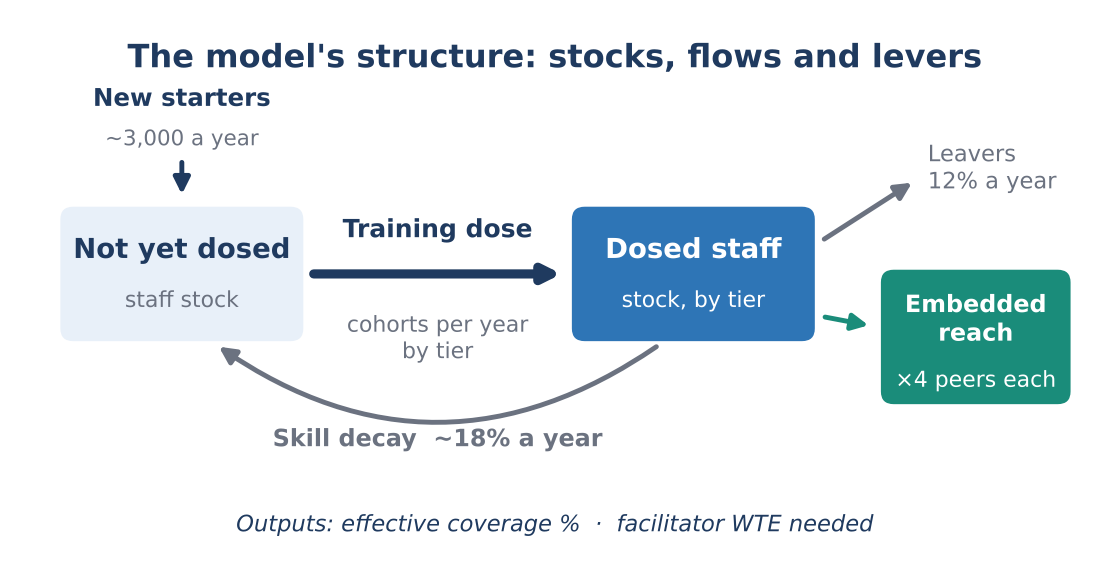
Figure 1. A simplified view of the model: training moves staff into the dosed stock, while turnover and skill decay drain it.
What I did
-
Turned the dosing approach into numbers. Sized each tier for a 25,000-person workforce and gave each its own training intensity and duration.
-
Built the stock-and-flow model. Modelled training cohorts and new starters flowing in, turnover (12%) and skill decay (18%) flowing out, and the embedded reach of practitioners, who each pass improvement skills on to around four colleagues.
-
Converted training into staffing. Translated throughput into delivery capacity (30 cohorts of 20 a year, one facilitator for every 25 practitioners in training) to show the whole-time equivalent (WTE) faculty needed each year.
-
Built in levers. Made the key assumptions adjustable, including how many people we train each year and the mix of people at each tier, so leaders can test options themselves rather than accept a single answer.
-
Wrote the executive briefing. Turned the results into a short deck setting out the timescale, the resources and the conditions the plan depends on.
Levers we can pull
Every option involves a trade-off, and the model makes each one visible. Two levers matter most:
-
Training throughput. Training more people each year reaches the whole workforce sooner, but needs more faculty and releases more staff from clinical work at once. Training fewer takes longer but may be far more realistic for services to sustain. At 600 practitioners a year we reach everyone by Year 4; at 300 it takes seven years or more.
-
The mix of people at each tier. Changing how many experts, coaches, practitioners and aware staff we aim for shifts both the cost and the shape of the capability we end up with. More practitioners means wider embedded reach; more coaches and experts means deeper support for complex work.
Because the levers and their effects are on the table, the compromises are transparent. Leaders can see what a slower pace or a different mix costs and gains, and agree a programme they can stand behind for the many years it will run.
What the model showed
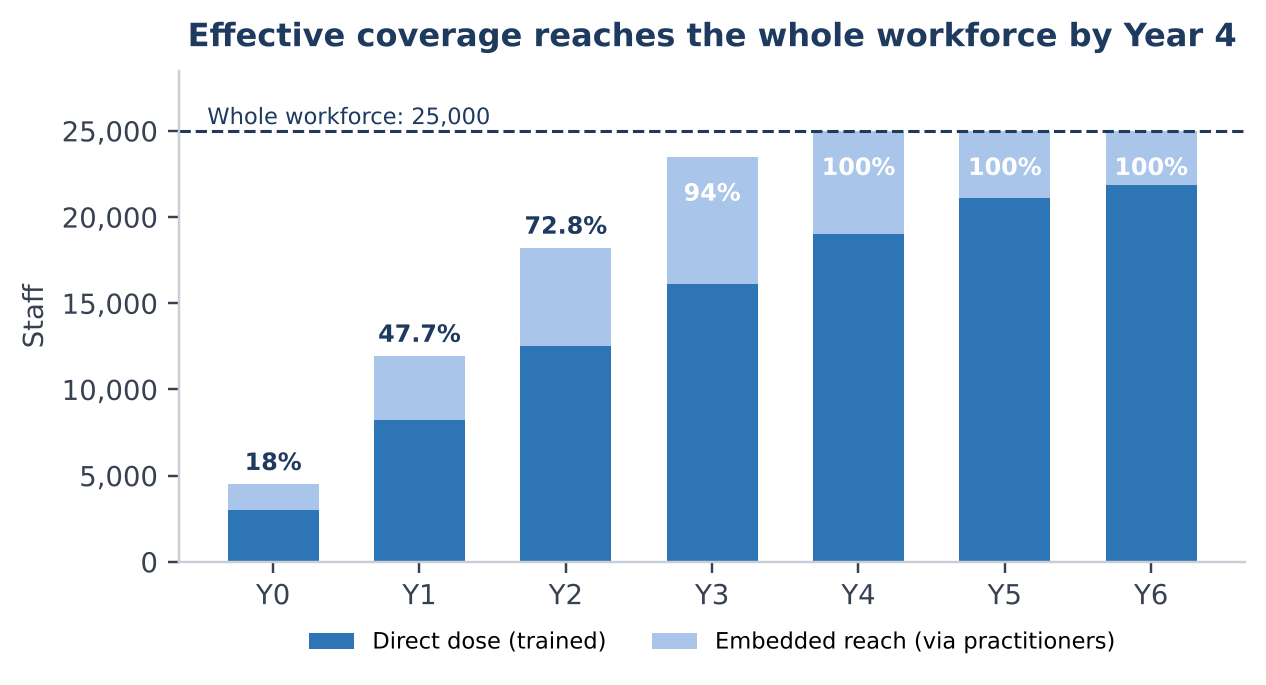
Figure 2. Effective coverage by year in the central scenario: staff trained directly plus colleagues reached through practitioners.
-
It takes three to four years. In the central scenario, effective coverage rises from 18% to 48% in Year 1, 94% by Year 3 and the whole workforce by Year 4, when the programme moves to a maintenance dose.
-
The multiplier is the efficiency engine. By Year 3, practitioners reach around 7,400 colleagues on top of the 16,100 trained directly. If isolated practitioners reach 1.5 colleagues instead of 4, Year 3 coverage falls from 94% to about 55%.
-
Skills need topping up. Turnover and skill fade erode gains every year, so the plan needs a refresher every 18–24 months.
-
Equity has to be designed in. Digital-first training tends to miss Band 1–4, night-shift and community staff, so the plan needs explicit ways to reach them.
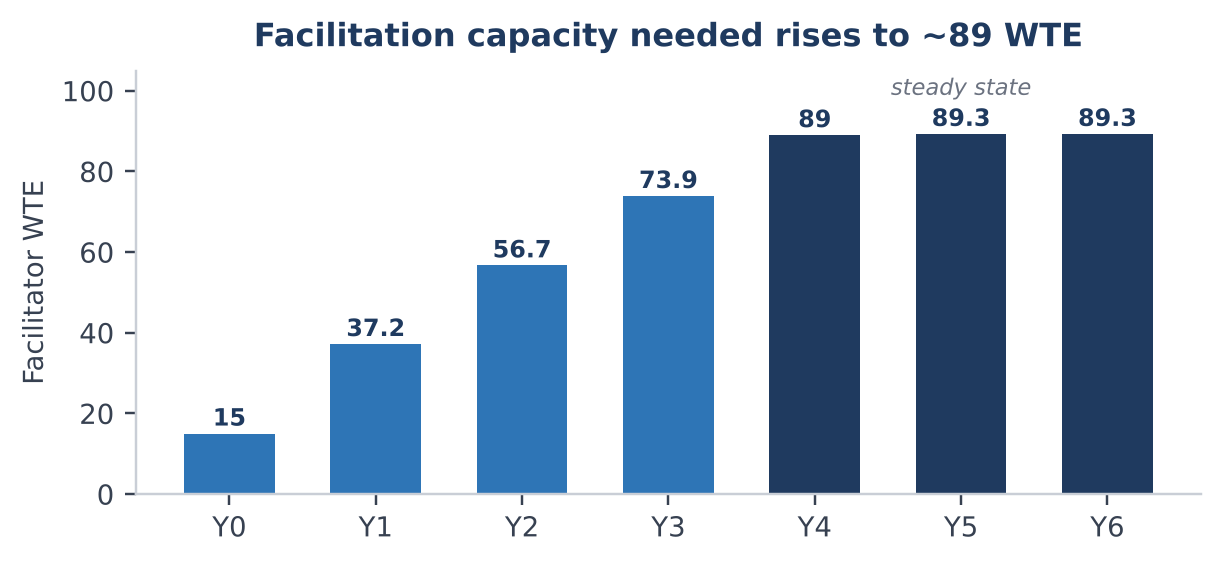
Figure 3. Facilitation capacity needed each year in the central scenario, in whole-time equivalents (WTE).
Facilitation need grows from 15 WTE to around 89 WTE at steady state. That is more than a central team can provide, so the model pointed to a shared approach: a small core of improvement specialists, plus clinicians and managers in each clinical group and corporate service with a protected fraction of their time for improvement.
From model to a shared plan
The model gives us the numbers to design the training programme, decide how many people to employ to build the resources and deliver the training, and build a business case on a realistic timescale. More importantly, it is the basis for working with corporate leaders and senior leaders from each clinical group on how we build this capability together. It sets out four conditions for that conversation:
-
Commit to a multi-year horizon. Meaningful coverage takes years, and stopping early resets the clock.
-
Share the faculty. Clinical groups and corporate services hold fractional improvement roles and protect them from operational pressure.
-
Invest in the community of practice. The four-fold multiplier only holds if practitioners have supervision, tools and peer support.
-
Build equity in from day one. Otherwise capability concentrates in the parts of the organisation that are already well resourced.
Next, we calibrate the model against confirmed delivery capacity, agree with each clinical group and corporate area the pace and mix they can support and the faculty they can contribute, set coverage and equity milestones for Years 1 and 3, and test the multiplier against real community of practice data.
Skills demonstrated
System dynamics modelling · stock-and-flow design · simulation in Insight Maker · scenario and sensitivity analysis · workforce and capacity planning · turning an IHI framework into a quantitative model · using models to support collaborative decision-making · data visualisation · writing for senior leaders
Figures are modelled projections from the central scenario, not measured outcomes. Reference: Lloyd R. Building improvement capacity and capability: a “dosing” approach. Healthcare Executive, May/June 2018, 68–71.